

Project involving innovative application of atomic force microscopy recognized by Natura & Co. group
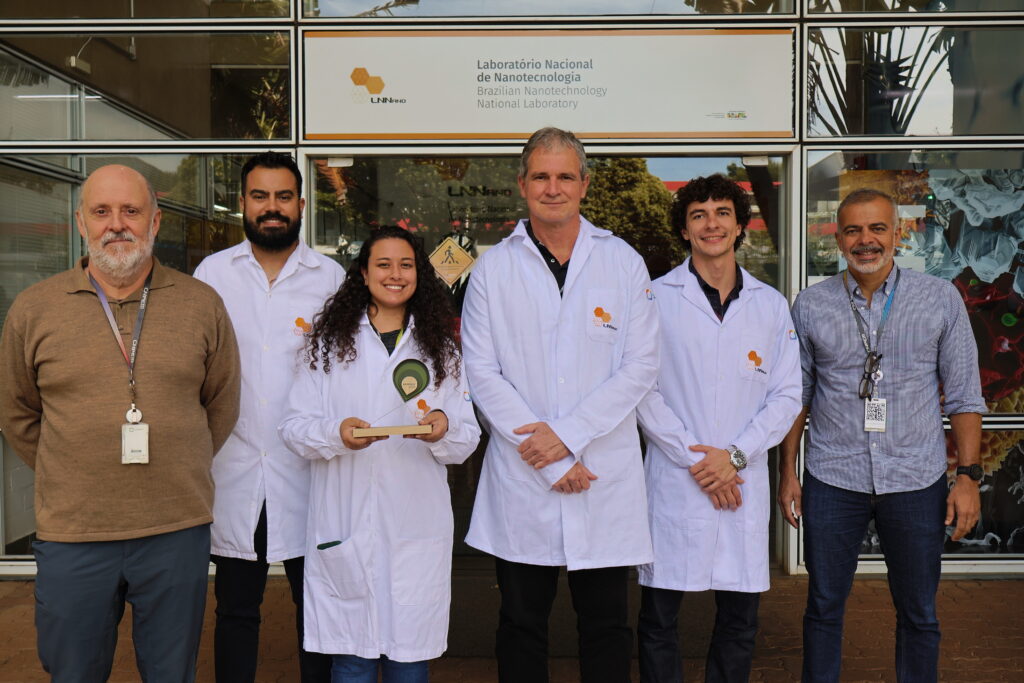
CNPEM is one of the winners of the Embrace 2025 – Value Projects – Innovation Funnel award, a recognition from the Natura & Co group to foster, reward and increase connections with its partners and suppliers. This prize for valuable and innovative projects was officially granted on June 9.
The MÍSTICA project, carried out by CNPEM’s Atomic Force Microscopy Laboratory team at the National Nanotechnology Laboratory, won the R&D category. The study, which has been underway in partnership with the Natura company since 2017, employs atomic force microscopy (AFM) to investigate the mechanical properties of large numbers of hair samples subjected to different degradation processes and treatments, with nanometric resolution.
Macroscopic properties that can be perceived by touch (like softness, roughness and slip resistance) are interpreted as collective manifestations of countless interactions occurring at the nanometric scale on the surface of each strand of hair. The AFM approach makes it possible to assess the topographic and mechanical changes induced in these materials, contributing to our understanding of the structural and functional effects associated with the conditions under study.
Bruna Sedaca, a technological development analyst at CNPEM who played a key role in the project, explained that “the technical challenge began with preparing the hair samples, and continued through the numerous atomic force microscopy analyses and analysis of the results. We had to develop methods for mechanical fixation of the hair strands, testing techniques and microscopy parameters, as well as to interpret the results.”
“More than just a biological fiber, hair carries with it identity, self-esteem and personal expression. It is precisely this human dimension that makes this work so significant: transforming cutting-edge scientific knowledge into solutions that directly impact people’s everyday lives, as well as their own stories,” noted Carlos Costa, a CNPEM specialist and coordinator of the Atomic Force Microscopy Laboratory.
The results showed how advanced approaches in nano-scale characterization using AFM can yield robust findings with potential for application, helping to develop safer and more effective products and technologies.
“When I joined CNPEM just over a year ago to work on this project, I had the opportunity to expand my application of the AFM technique in an innovation context, alongside a partnering team, contributing to work that today has been recognized with this award — a trajectory I receive with profound gratitude, pride, and a sense of responsibility. I was very honored and grateful for the recognition,” said Bruna Sedaca.
Atomic force microscopy
Although the term “microscopy” is historically used for this class of instruments, ATM does not use lenses to form images. Instead, it more closely resembles a high-resolution mechanical profilometer that maps the surface of a sample using a probe with a very sharp end while simultaneously investigating the physical and chemical interactions that take place where the tip of the probe meets the sample material.
The data is acquired sequentially: the probe moves in a line from point to point along the surface, repeating this movement until a defined area of the sample is mapped. The resulting image is constructed by associating the data obtained at each measurement point to generate a three-dimensional topographic representation of the surface. This technique makes it possible to correlate the topography with local properties like stiffness, adhesion, and friction, depending on the operation mode used.
CNPEM open AFM facility
The Atomic Force Microscopy Laboratory, an open facility at LNNano/CNPEM, offers five different experimental platforms for atomic force microscopes equipped with a wide range of applications related to the areas of physics, chemistry, biology and engineering. Besides providing a multi-user environment where academic and industrial research projects are conducted, this laboratory also trains users of all levels, from basic to advanced, as part of efforts to publicize and disseminate AFM techniques in Brazil.
The Brazilian Nanotechnology National Laboratory (LNNano) works in research and development at the nano scale using sophisticated infrastructure and highly specialized teams that can search for answers to scientific challenges and leverage technology solutions. Its open facilities comprise a center that is unrivaled in Brazil and include electron and atomic force microscopy, as well as clean rooms and laboratory spaces that allow activities ranging from materials synthesis and characterization to device manufacturing. Scientific research at LNNano covers strategic topics where nanoscience and nanotechnology can help solve problems facing the country, in areas like renewable energy, materials for sustainability, health and quantum devices. LNNano is part of the Brazilian Center for Research in Energy and Materials (CNPEM) in Campinas, São Paulo, a private, non-profit organization overseen by the Ministry of Science, Technology and Innovation (MCTI).About LNNano
About CNPEM
The Brazilian Center for Research in Energy and Materials (CNPEM) is home to a state-of-the-art, multi-user and multidisciplinary scientific environment and works on different fronts within the Brazilian National System for Science, Technology and Innovation. A social organization overseen by the Ministry of Science, Technology and Innovation (MCTI), with the involvement of the Ministry of Education and the Ministry of Health, CNPEM is driven by research that impacts the areas of health, energy, renewable materials, and sustainability. It is responsible for Sirius, the largest assembly of scientific equipment constructed in the country, and is currently constructing Project Orion, a laboratory complex for advanced pathogen research. Highly specialized science and engineering teams, sophisticated infrastructure open to the scientific community, strategic lines of investigation, innovative projects involving the productive sector, and training for researchers and students are the pillars of this institution that is unique in Brazil and able to serve as a bridge between knowledge and innovation. CNPEM's research and development activities are carried out through its four National Laboratories: Synchrotron Light (LNLS), Biosciences (LNBio), Nanotechnology (LNNano), Biorenewables (LNBR), as well as its Technology Unit (DAT) and the Ilum School of Science — an undergraduate program in Science and Technology.