

Researchers develop chips with a high density of electrochemical sensors integrated into microfluidics capable of performing rapid biological analyses using a low-cost, portable platform
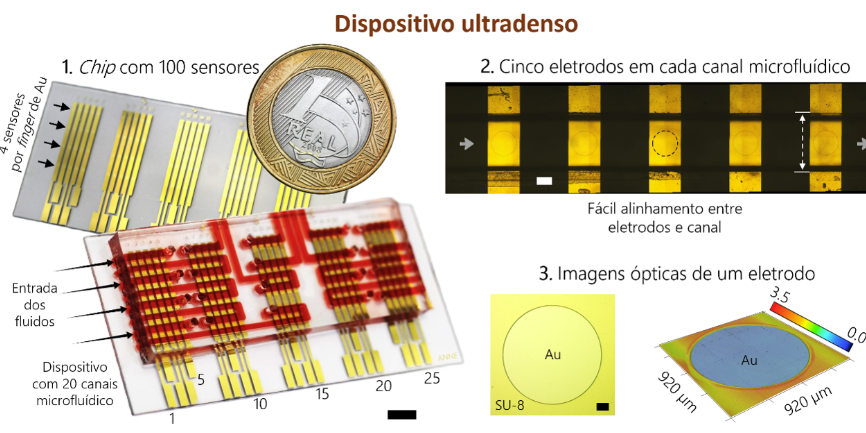
A group from the Brazilian Nanotechnology National Laboratory at the Brazilian Center for Research in Energy and Materials (LNNano/CNPEM), coordinated by researcher Renato Sousa Lima, developed a device that functions as a versatile platform for detecting chemical substances, monitoring cellular processes, and conducting simultaneous large-scale experiments, known as high-throughput. The work was published as a featured article on the cover of the scientific journal ACS Sensors. Among the demonstrated applications are the diagnosis of MPOX, the monitoring of phosphate, a compound relevant for clinical tests, and the monitoring of cancer cell proliferation. The study was funded by the Research Center of Molecular Engineering for Advanced Materials (CEMol).
The central idea of the device is to concentrate many sensors in a very small space, allowing for cost reduction, compatibility with microfluidics (an essential tool for automation purposes in routine testing), and the testing of multiple samples in just a few minutes. These features could make it possible to speed up medical examinations and conduct mass testing, which is essential in epidemic and pandemic scenarios. Furthermore, this arrangement allows for the miniaturization of the system, which makes it possible to connect it to portable equipment. The method has potential applications in the healthcare field, such as in testing new drugs, precision oncology, and decentralized disease diagnosis.
The key difference in this work lies in the use of switchable electrodes, which can alternate their functions throughout serial experiments. In conventional electrochemical systems, each electrode has a fixed role. In the developed device, gold electrodes of the same size can act either as a working electrode or as a reference electrode (or, more precisely, quasi-reference in the case of the manufactured chips), depending on how they are connected and manufactured. In practical terms, it is as if each point on the chip could function as both an input and an output of the electrical system, depending on the reference adopted. This flexibility drastically reduces the complexity of the manufacturing process for high-density devices, usually based on 3D manufacturing processes that require some sequential steps. The developed chip, on the other hand, is based on 2D electrodes, which simplifies manufacturing, requiring just one step.

The chip functions as a versatile platform for detecting chemical substances, monitoring cellular processes, and conducting simultaneous large-scale experiments. Credits: Renato Sousa Lima LNNano/CNPEM
Among the most promising uses of the developed device is its application in precision medicine. In the future, chips like this could be used to quickly test different treatments on tumor cells taken from the patient themselves. Instead of choosing a chemotherapy drug by trial and error, it would be possible to evaluate, on a large scale and in a short time, which drug works best for that specific case, with greater therapeutic efficiency and fewer side effects. This type of personalized screening can make cancer treatment more effective, faster, and potentially less aggressive. This work is an example of how advances in molecular engineering for device manufacturing can improve healthcare.
The journal cover aims to depict the functioning of the developed chips, with planar gold electrodes of the same size being alternated between working electrodes (WE) and quasi-reference electrodes (QRE) throughout serial measurements. The figures and electrons symbolize oxidation and reduction reactions occurring on the surfaces of the switchable electrodes, while the hourglass suggests the passage of time and the use of the same electrode for different functions during sequential analyses.
Read the full article at: https://doi.org/10.1021/acssensors.5c03049
Title: Switchable Electrode-Enabled High-Density Two-Dimensional Chips: A Simple, Generalizable Approach to Yield High-Throughput Electrochemical Analyses
Authors: Bruna M. Hryniewicz, Gabriela Zoia, Bruna Bragantin, Thiago S. Martins, Gabriel J. C. Pimentel, Juliana N. Y. Costa, Pedro H. N. da Silva, Paula C. R. Corsato, Karl J. Clinckspoor, Murilo Santhiago, Flávio M. Shimizu, Charles S. Henry, Osvaldo N. Oliveira Jr., Renato S. Lima
Journal: ACS Sensors
About LNNano
The Brazilian Nanotechnology National Laboratory (LNNano) works in research and development at the nano scale using sophisticated infrastructure and highly specialized teams that can search for answers to scientific challenges and leverage technology solutions. Its open facilities comprise a center that is unrivaled in Brazil and include electron and atomic force microscopy, as well as clean rooms and laboratory spaces that allow activities ranging from materials synthesis and characterization to device manufacturing. Scientific research at LNNano covers strategic topics where nanoscience and nanotechnology can help solve problems facing the country, in areas like renewable energy, materials for sustainability, health and quantum devices. LNNano is part of the Brazilian Center for Research in Energy and Materials (CNPEM) in Campinas, São Paulo, a private, non-profit organization overseen by the Ministry of Science, Technology and Innovation (MCTI).
About CNPEM
The Brazilian Center for Research in Energy and Materials (CNPEM) is home to a state-of-the-art, multi-user and multidisciplinary scientific environment and works on different fronts within the Brazilian National System for Science, Technology and Innovation. A social organization overseen by the Ministry of Science, Technology and Innovation (MCTI), with the involvement of the Ministry of Education and the Ministry of Health, CNPEM is driven by research that impacts the areas of health, energy, renewable materials, and sustainability. It is responsible for Sirius, the largest assembly of scientific equipment constructed in the country, and is currently constructing Project Orion, a laboratory complex for advanced pathogen research. Highly specialized science and engineering teams, sophisticated infrastructure open to the scientific community, strategic lines of investigation, innovative projects involving the productive sector, and training for researchers and students are the pillars of this institution that is unique in Brazil and able to serve as a bridge between knowledge and innovation. CNPEM's research and development activities are carried out through its four National Laboratories: Synchrotron Light (LNLS), Biosciences (LNBio), Nanotechnology (LNNano), Biorenewables (LNBR), as well as its Technology Unit (DAT) and the Ilum School of Science — an undergraduate program in Science and Technology.