

Microfluidic device makes it possible to cultivate three-dimensional cells and perform toxicity testing on drugs, nanomaterials and environmental pollutants in conditions more closely resembling humans and animals
Researchers from the Brazilian Center for Research in Energy and Materials (CNPEM) have developed a reversible microfluidic platform for cultivating cells in three-dimensional (3D) structures and testing drugs and materials under conditions that better replicate the conditions observed in living organisms. This technology offers potential for applications in drug development, evaluating the toxicity of new materials, and ecotoxicological studies investigating the effects materials have on ecosystems.

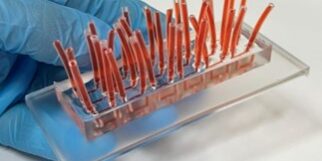
Reversible microfluidic platform. Image shows chip during toxicology test (CNPEM)
The 3D cell models are an advance compared to traditional cultures on flat surfaces since they more faithfully reproduce the characteristics of living tissues, such as organization and communication between cells and contact with nutrients. From laboratory tests (in vitro assays), these 3D models can more accurately indicate the effect substances (such as pharmaceuticals, nanomaterials or environmental pollutants) will have on cells, thus reducing the need for animal testing and accelerating innovation on safe and sustainable foundations.
The new platform uses microfluidics, a system that precisely controls the flow of nutrients, oxygen and test substances at a micrometric scale (10–6 m). Made of PDMS, a transparent, biocompatible and low-cost polymer material, the system can also be automated and carry out multiple experiments, boosting efficiency. Because it is reversible, the device can be opened to perform subsequent tests on the cultured cells.

Reversible microfluidic platform. Image shows how the chip can be opened after use (CNPEM)
The study was funded by the Molecular Engineering for Advanced Materials Research Center (CEMol/FAPESP) and was published in the international journal ACS Measurement Science Au. The lead author, Iris Renata Sousa Ribeiro, is a postdoctoral researcher at CNPEM in the Nanotechnology National Laboratory (LNNano) and highlights that the study offers three main contributions.
The first is the development of a standardized, reproducible and easy-to-use protocol for cultivating 3D cell models and subsequent exposure to different drugs or materials (such as nanomaterials). “Generating an experimental protocol that can be replicated by non-specialist users ensures broad use of our platform in routine in vitro cell testing,” explains Iris Ribeiro.
The second contribution is the ability to recover intact 3D cells for detailed analysis after the tests are complete. “This capacity, which is not common in microfluidic systems, paves the way for important fundamental studies on the mechanism of action in the drugs or target materials being investigated,” she adds.
The third contribution is that the system permits toxicity tests of different types of molecules and materials under flow conditions that better reproduce the environment within our bodies. “This makes the results achieved in the laboratory closer to real ones, in other words, those obtained in living organisms,” says Iris Ribeiro.
As a next step, the team intends to make the platform available to researchers from different institutions outside CNPEM so they can perform toxicity tests on materials using various types of 3D cell models. “We continue to be driven by the goal to make our platform a viable option for users across the country in research within the fields of pharmacology, biotechnology, nanotechnology, material sciences and ecotoxicology,” she adds.
The study was coordinated by Renato Sousa Lima and also included Diego Martinez, both LNNano-CNPEM researchers connected to CEMol. Collaborators also included undergraduate students at CNPEM’s Ilum School of Science, Katarina Vilarins and Eloisa Souza.
The full article can be found at: https://pubs.acs.org/doi/10.1021/acsmeasuresciau.6c00140.
About LNNano
The Brazilian Nanotechnology National Laboratory (LNNano) works in research and development at the nano scale using sophisticated infrastructure and highly specialized teams that can search for answers to scientific challenges and leverage technology solutions. Its open facilities comprise a center that is unrivaled in Brazil and include electron and atomic force microscopy, as well as clean rooms and laboratory spaces that allow activities ranging from materials synthesis and characterization to device manufacturing. Scientific research at LNNano covers strategic topics where nanoscience and nanotechnology can help solve problems facing the country, in areas like renewable energy, materials for sustainability, health and quantum devices. LNNano is part of the Brazilian Center for Research in Energy and Materials (CNPEM) in Campinas, São Paulo, a private, non-profit organization overseen by the Ministry of Science, Technology and Innovation (MCTI).
About CNPEM
The Brazilian Center for Research in Energy and Materials (CNPEM) is home to a state-of-the-art, multi-user and multidisciplinary scientific environment and works on different fronts within the Brazilian National System for Science, Technology and Innovation. A social organization overseen by the Ministry of Science, Technology and Innovation (MCTI), with the involvement of the Ministry of Education and the Ministry of Health, CNPEM is driven by research that impacts the areas of health, energy, renewable materials, and sustainability. It is responsible for Sirius, the largest assembly of scientific equipment constructed in the country, and is currently constructing Project Orion, a laboratory complex for advanced pathogen research. Highly specialized science and engineering teams, sophisticated infrastructure open to the scientific community, strategic lines of investigation, innovative projects involving the productive sector, and training for researchers and students are the pillars of this institution that is unique in Brazil and able to serve as a bridge between knowledge and innovation. CNPEM's research and development activities are carried out through its four National Laboratories: Synchrotron Light (LNLS), Biosciences (LNBio), Nanotechnology (LNNano), Biorenewables (LNBR), as well as its Technology Unit (DAT) and the Ilum School of Science — an undergraduate program in Science and Technology.