

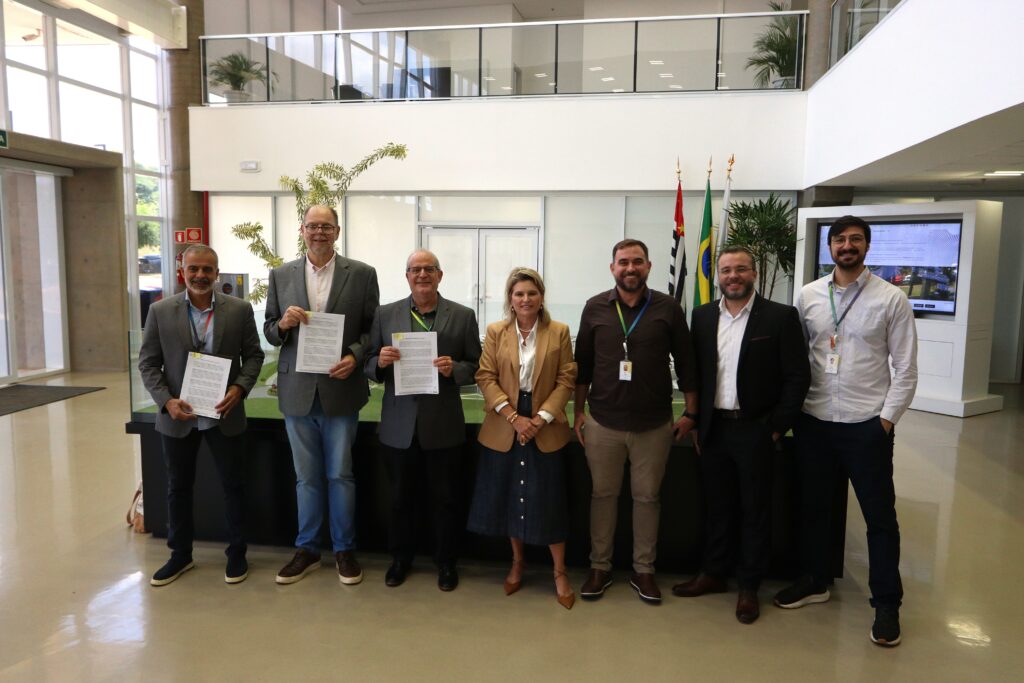
The Brazilian Center for Research in Energy and Materials (CNPEM) has signed an agreement with the Government of the State of Paraná, through the Secretariat for Innovation and Artificial Intelligence (SEIA), and with the State University of Londrina (UEL) to expand research, training, and innovation initiatives in Artificial Intelligence and Sustainable Materials. The initiative has the potential to drive the development of solutions aimed at discovering, characterizing, and applying safer, more efficient, and more sustainable materials, as well as using artificial intelligence to enhance experimental processes, data management, and scientific collaboration. The agreement also includes training activities, student and researcher exchanges, and—strategically—the initial coordination for structuring a future Artificial Intelligence Center for Sustainable Materials, in collaboration with national and international partners.
According to Diego Martinez, CNPEM researcher and one of the coordinators of the partnership, “this is undoubtedly a very important collaboration to accelerate technological development and innovation in by-design materials, especially considering life cycle, competitive advantages, and the productive chains of Paraná.”
Strengthening CNPEM’s scientific presence across different regions of the country
Within the scope of the partnership, UEL contributes with its activities in education, research, and outreach, as well as its regional presence and engagement with the productive sector. Students and researchers from the university will gain expanded access to advanced environments for experimentation, engineering, and data analysis, strengthening their training in emerging technologies.
SEIA, in turn, supports broader coordination within the state’s innovation ecosystem, fostering connections among universities, companies, and technological development initiatives. For Paraná’s innovation landscape, the partnership creates conditions to accelerate knowledge transfer to industry, stimulate science-based innovation, and support the emergence of new processes, products, and services related to sustainability and artificial intelligence.
With this new agreement, CNPEM expands its national reach by integrating state universities, innovation environments, and productive ecosystems from different regions. According to Antonio José Roque, CNPEM’s Director-General, “this is an opportunity to broaden the impact of the science developed in our laboratories, bring new talents closer to the cutting-edge scientific infrastructure available in Campinas, and stimulate innovation pathways based on AI and sustainable materials.”
About LNNano
The Brazilian Nanotechnology National Laboratory (LNNano) works in research and development at the nano scale using sophisticated infrastructure and highly specialized teams that can search for answers to scientific challenges and leverage technology solutions. Its open facilities comprise a center that is unrivaled in Brazil and include electron and atomic force microscopy, as well as clean rooms and laboratory spaces that allow activities ranging from materials synthesis and characterization to device manufacturing. Scientific research at LNNano covers strategic topics where nanoscience and nanotechnology can help solve problems facing the country, in areas like renewable energy, materials for sustainability, health and quantum devices. LNNano is part of the Brazilian Center for Research in Energy and Materials (CNPEM) in Campinas, São Paulo, a private, non-profit organization overseen by the Ministry of Science, Technology and Innovation (MCTI).
About CNPEM
The Brazilian Center for Research in Energy and Materials (CNPEM) is home to a state-of-the-art, multi-user and multidisciplinary scientific environment and works on different fronts within the Brazilian National System for Science, Technology and Innovation. A social organization overseen by the Ministry of Science, Technology and Innovation (MCTI), CNPEM is driven by research that impacts the areas of health, energy, renewable materials, and sustainability. It is responsible for Sirius, the largest assembly of scientific equipment constructed in the country, and is currently constructing Project Orion, a laboratory complex for advanced pathogen research. Highly specialized science and engineering teams, sophisticated infrastructure open to the scientific community, strategic lines of investigation, innovative projects involving the productive sector, and training for researchers and students are the pillars of this institution that is unique in Brazil and able to serve as a bridge between knowledge and innovation. CNPEM’s research and development activities are carried out through its four National Laboratories: Synchrotron Light (LNLS), Biosciences (LNBio), Nanotechnology (LNNano), Biorenewables (LNBR), as well as its Technology Unit (DAT) and the Ilum School of Science — an undergraduate program in Science and Technology supported by the Ministry of Education (MEC).