

Research conducted at CNPEM combines waste from agroindustry and biopolymers to produce a light, resistant material with controllable biodegradation, with a patent application filed for this new technology
It is light enough to sit on top of a plant’s leaves, but strong enough to support loads much greater than its own mass. These are some characteristics of a new foam developed at the Brazilian Center for Research in Energy and Materials (CNPEM) using plant wastes and biopolymers as raw materials. This material has the potential to replace conventional plastic foams such as expanded polystyrene (better known as Styrofoam) in packaging to protect fragile products and food.
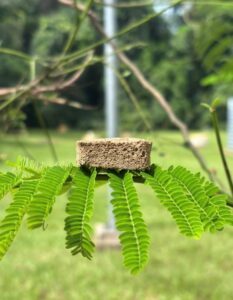
The new foam resting on the leaves of a plant, demonstrating its low density
Produced from particles of plant biomass from sugarcane bagasse or by-products from the eucalyptus industry, the foam’s main characteristics include lightness, mechanical resistance and biodegradability. Materials made from the foam demonstrated low density and compressive strength comparable to plastic foams. Its porous structure absorbs impacts to protect products during storage and transportation. Another differential is the potential to control the pace of biodegradation through the components used in production. Biomass particles and biopolymers can be selected to develop formulations that degrade more quickly, suitable for short-term packaging, or materials with slower degradation for applications that require longer storage times.
“Throughout our work, we were able to monitor how each change in formulation affected the material and to use this knowledge to attain light yet strong foams,” says Victoria Barros Pinheiro da Silva, a CNPEM collaborating student researcher who led the study.
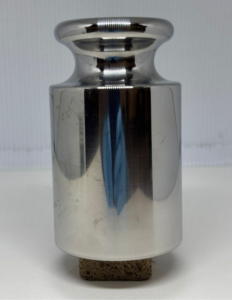
Biodegradable foam supporting a 2 kg weight, over 600 times its own mass
The manufacturing process developed by the researchers begins with mixing water with plant biomass particles, biopolymers like starch or pectin, and a surfactant. These biopolymers contribute to adhesion between the plant particles and stabilization of the foam structure. The mixture is then agitated mechanically; this incorporates air bubbles, increasing its volume and forming a porous structure responsible for the foam’s low density. The wet foam is then transferred into molds and dried in a kiln to produce the solid material.
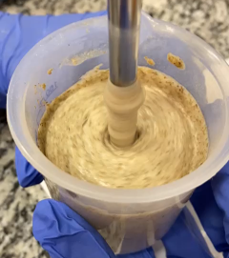
Process of making biodegradable foams
“A very interesting outcome was to show that plant waste can be transformed into materials with potential for use in packaging, with relatively simple processing,” notes Mariana Martinussi Godoy, a CNPEM collaborating student researcher who participated in the study.
The research showed that the foam’s characteristics can be modulated by selecting the type, size and composition of the biomass particles as well as the biopolymer used. These variables influence pore organization, mechanical resistance, and especially how quickly the material biodegrades.
“The differential of this technology lies not only in producing a biodegradable foam, but in controlling its biodegradation after use. By choosing the components in its formulation, we can adjust the speed of biodegradation to the needs of each application,” explains Elisa Silva Ferreira, a researcher at CNPEM and coordinator of the study.
Potential applications include food trays, box fillers for shipping and packaging designed to protect fragile objects. In October 2026, CNPEM filed an application to patent the technology and its uses with Brazilian National Institute for Industrial Property (INPI), under the number BR 10 2026 026387 7. Filing the patent is an important step in the protection of intellectual property and lays the groundwork for future transfer of this technology to the productive sector.
Transforming sugarcane bagasse and eucalyptus waste into bioproducts expands the possibilities for using raw materials that are already part of important Brazilian production chains. In addition to adding value to this waste, developing new materials from renewable sources can drive more sustainable solutions and create opportunities for new products and markets.
The results of the research were published in September 2026 in an article entitled “Using Biomass Particles and Biopolymers to Control the Mechanical Properties and Biodegradability of Renewable Foams” in the journal ACS Sustainable Resource Management. The study was coordinated by CNPEM researcher Elisa Silva Ferreira and included undergraduate students Victoria Barros Pinheiro da Silva, Luygui Gaspardo Silva, Mariana Martinussi Godoy and UFSCAR professor Daniel Baron. The research received funding from FAPESP through the Young Researcher program (process 2023/09659-7), grant 2023/14118-5 and CEMol, the Center for Research in Molecular Engineering for Advanced Materials, supported by FAPESP’s CEPID program (process 2024/00989-7).
Read the full article here.
About LNNano
The Brazilian Nanotechnology National Laboratory (LNNano) works in research and development at the nano scale using sophisticated infrastructure and highly specialized teams that can search for answers to scientific challenges and leverage technology solutions. Its open facilities comprise a center that is unrivaled in Brazil and include electron and atomic force microscopy, as well as clean rooms and laboratory spaces that allow activities ranging from materials synthesis and characterization to device manufacturing. Scientific research at LNNano covers strategic topics where nanoscience and nanotechnology can help solve problems facing the country, in areas like renewable energy, materials for sustainability, health and quantum devices. LNNano is part of the Brazilian Center for Research in Energy and Materials (CNPEM) in Campinas, São Paulo, a private, non-profit organization overseen by the Ministry of Science, Technology and Innovation (MCTI).
About CNPEM
The Brazilian Center for Research in Energy and Materials (CNPEM) is home to a state-of-the-art, multi-user and multidisciplinary scientific environment and works on different fronts within the Brazilian National System for Science, Technology and Innovation. A social organization overseen by the Ministry of Science, Technology and Innovation (MCTI), with the involvement of the Ministry of Education and the Ministry of Health, CNPEM is driven by research that impacts the areas of health, energy, renewable materials, and sustainability. It is responsible for Sirius, the largest assembly of scientific equipment constructed in the country, and is currently constructing Project Orion, a laboratory complex for advanced pathogen research. Highly specialized science and engineering teams, sophisticated infrastructure open to the scientific community, strategic lines of investigation, innovative projects involving the productive sector, and training for researchers and students are the pillars of this institution that is unique in Brazil and able to serve as a bridge between knowledge and innovation. CNPEM's research and development activities are carried out through its four National Laboratories: Synchrotron Light (LNLS), Biosciences (LNBio), Nanotechnology (LNNano), Biorenewables (LNBR), as well as its Technology Unit (DAT) and the Ilum School of Science — an undergraduate program in Science and Technology.